Japanese Term for No Mistakes in Art Riki Tiki

Zen garden of Ryōan-ji. It was congenital during the Higashiyama menses. The clay wall, which is stained by age with subtle dark-brown and orange tones, reflects sabi principles, with the rock garden reflecting wabi principles.[1]

A Japanese tea house which reflects the wabi-sabi aesthetic in Kenroku-en ( 兼六園 ) Garden
In traditional Japanese aesthetics, wabi-sabi ( 侘寂 ) is a earth view centered on the acceptance of transience and imperfection.[2] The aesthetic is sometimes described every bit one of affectionate dazzler that is "imperfect, impermanent, and incomplete" in nature.[3] Information technology is prevalent throughout all forms of Japanese fine art.[4] It is a concept derived from the Buddhist teaching of the three marks of existence ( 三法印 , sanbōin ), specifically impermanence ( 無常 , mujō ), suffering ( 苦 , ku ) and emptiness or absenteeism of self-nature ( 空 , kū ).
Characteristics of wabi-sabi aesthetics and principles include asymmetry, roughness, simplicity, economic system, thrift, modesty, intimacy, and the appreciation of both natural objects and the forces of nature.
Description [edit]
According to Leonard Koren, wabi-sabi can be described as "the nearly conspicuous and characteristic feature of what we think of as traditional Japanese beauty. Information technology occupies roughly the same position in the Japanese pantheon of aesthetic values equally do the Greek ideals of dazzler and perfection in the Westward." Another description of wabi-sabi by Andrew Juniper notes that, "If an object or expression tin can bring about, within us, a sense of serene melancholy and a spiritual longing, then that object could be said to be wabi-sabi ."[five] For Richard Powell, " Wabi-sabi nurtures all that is accurate by acknowledging iii simple realities: nothing lasts, nothing is finished, and nothing is perfect."[half-dozen]
The words "wabi" and "sabi" do not translate directly into English language; 'wabi' originally referred to the loneliness of living in nature, remote from society; 'sabi' meant "chill", "lean" or "withered". Around the 14th century, these meanings began to change, taking on more positive connotations.[3]
After centuries of incorporating artistic and Buddhist influences from Mainland china, wabi-sabi eventually evolved into a distinctly Japanese platonic. Over time, the meanings of wabi and sabi changed to be more than lighthearted and hopeful. Around 700 years ago, peculiarly among the Japanese dignity, understanding emptiness and imperfection was honored as tantamount to the starting time step to satori , or enlightenment. In today's Japan, the meaning of wabi-sabi is ofttimes condensed to "wisdom in natural simplicity". In art books, information technology is typically divers equally "flawed beauty".[7] Wabi-sabi artworks often emphasize the procedure of making the piece and that is ultimately incomplete.[8]
From an engineering or pattern signal of view, wabi may be interpreted equally the imperfect quality of whatsoever object, due to inevitable limitations in design and construction/industry especially with respect to unpredictable or changing usage weather; in this instance, sabi could be interpreted as the aspect of imperfect reliability, or the limited mortality of any object, hence the phonological and etymological connectedness with the Japanese word sabi ( 錆 , "to rust") (lit., "to rust"). Although the kanji characters for "rust" are not the aforementioned as sabi ( 寂 ) in wabi-sabi , the original spoken word (pre-kanji, yamato-kotoba ) are believed to exist i and the aforementioned.[9] [x]

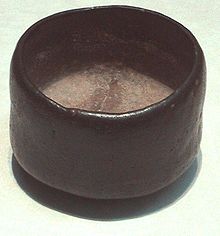
Modern tea vessel made in the wabi-sabi style
Wabi and sabi both propose sentiments of desolation and solitude. In the Mahayana Buddhist view of the universe, these may exist viewed as positive characteristics, representing liberation from a textile earth and transcendence to a simpler life. Mahayana philosophy itself, however, warns that genuine understanding cannot exist achieved through words or linguistic communication, and then accepting wabi-sabi on nonverbal terms may be the nigh appropriate approach.
In i sense wabi-sabi is a training whereby the student of wabi-sabi learns to find the well-nigh basic, natural objects interesting, fascinating and beautiful. Fading autumn leaves would be an example. Wabi-sabi can alter our perception of the world to the extent that a chip or scissure in a vase makes information technology more than interesting and gives the object greater meditative value. Similarly materials that age such as blank wood, paper and material become more interesting as they exhibit changes that can be observed over time.[ commendation needed ]
The wabi and sabi concepts are religious in origin, simply actual usage of the words in Japanese is often quite coincidental because of the syncretic nature of Japanese belief.
In Japanese arts [edit]
Many forms of Japanese fine art accept been influenced past Zen and Mahayana philosophy over the past thousand years, with the concepts of the credence and contemplation of imperfection, and abiding flux and impermanence of all things being particularly important to Japanese arts and culture.
As a result, many of these artforms contain and exemplify the ideals of wabi-sabi , and several display the concept'southward aesthetical senses particularly well. Examples include:
- Honkyoku (the traditional shakuhachi (bamboo flute) music of wandering Zen monks)
- Ikebana (the art of flower arrangement)
- The cultivation of bonsai (miniature trees) - a typical bonsai design features wood with a rough texture, pieces of deadwood, and trees with hollow trunks, all intended to highlight the passage of fourth dimension and nature. Bonsai are often displayed in the autumn or after they have shed leaves for the wintertime, in gild to adore their bare branches.
- Traditional Japanese gardens, such every bit Zen gardens (tray gardens)
- Japanese poetry
- Japanese pottery, such as Hagi ware, Raku ware and kintsugi
- Tea ceremony, by ways of an analogous study of action and environment.[eight]
A contemporary Japanese exploration of the concept of wabi-sabi can be found in the influential essay In Praise of Shadows by Jun'ichirō Tanizaki.
Western use [edit]
Many Western designers, writers, poets and artists have utilised wabi-sabi ideals within their work to varying degrees, with some because the concept a key component of their art, and others using it only minimally.
Designer Leonard Koren (born 1948) published Wabi-Sabi for Artists, Designers, Poets & Philosophers (1994)[iii] every bit an examination of wabi-sabi , contrasting it with Western ideals of beauty. According to Penelope Green, Koren'due south book after "became a talking bespeak for a wasteful culture intent on penitence and a touchstone for designers of all stripes."[eleven]
Wabi-sabi concepts historically had extreme importance in the development of Western studio pottery; Bernard Leach (1887–1979) was deeply influenced by Japanese aesthetics and techniques, which is evident in his foundational volume "A Potter's Volume".
The work of American artist John Connell (1940–2009) is also considered to be centered on the idea of wabi-sabi ;[12] other artists who accept employed the idea include former Stuckist artist and remodernist filmmaker Jesse Richards (born 1975), who employs information technology in almost all of his work, forth with the concept of mono no aware .
Some haiku in English language also adopt the wabi-sabi aesthetic in written manner, creating spare, minimalist poems that evoke loneliness and transience,[ citation needed ] such every bit Nick Virgilio'south "autumn twilight:/ the wreath on the door/ lifts in the air current".[13]
During the 1990s, the concept was borrowed past reckoner software developers and employed in agile programming and Wiki, used to draw acceptance of the ongoing imperfection of calculator programming produced through these methods.[xiv]
On xvi March 2009, Marcel Theroux presented "In Search of Wabi Sabi" on BBC Four, as part of the channel's Hidden Japan season of programming, travelling throughout Japan trying to understand the aesthetic tastes of its people. Theroux began past comically enacting a challenge from the book Living Wabi Sabi by Taro Gold, asking members of the public on a street in Tokyo to describe wabi-sabi - the results of which showed that, just as Gold predicted, "they volition likely give you a polite shrug and explain that Wabi Sabi is simply unexplainable."[15]
Run into also [edit]
- Clinamen
- Higashiyama Bunka in the Muromachi period
- Iki (a Japanese artful ideal)
- Mono no enlightened
- Shibui
- Teaism
- Wabi-cha
- Kintsugi (as well known as kintsukuroi )
- Tao Te Ching
- I Ching
References [edit]
- ^ 森神逍遥 『侘び然び幽玄のこころ』桜の花出版、2015年 Morigami Shouyo,"Wabi sabi yugen no kokoro : seiyo tetsugaku o koeru joi ishiki" (Japanese) ISBN 978-4434201424
- ^ "What Is Wabi-Sabi?". nobleharbor.com . Retrieved 2017-07-13 .
- ^ a b c Koren, Leonard (1994). Wabi-Sabi for Artists, Designers, Poets and Philosophers. Stone Bridge Printing. ISBN1-880656-12-4.
- ^ DAVIES, TREVOR (2018). 1001 IDEAS THAT Inverse THE WAY WE Recollect. [Place of publication not identified]: CASSELL ILLUSTRATED. p. 293. ISBN1-78840-088-7. OCLC 1032029879.
- ^ Juniper, Andrew (2003). Wabi Sabi: The Japanese Art of Impermanence . Tuttle Publishing. ISBN0-8048-3482-2.
- ^ Powell, Richard R. (2004). Wabi Sabi Unproblematic. Adams Media. ISBNi-59337-178-0.
- ^ Gold, Taro. (2004) Taro Gold'due south Living Wabi Sabi (Kansas City: Andrews McMeel Publishing, ISBN 0-7407-3960-3), pp. twenty–21.
- ^ a b John, Joseph D. (2007). "Experience equally Medium: John Dewey and a Traditional Japanese Aesthetic". The Journal of Speculative Philosophy. 21 (2): 83–ninety. ISSN 1527-9383.
- ^ 錆びをめぐる話題, 井上勝也, 裳華房, 1994
- ^ さびの文字 on the Kinugawa Chain Mfg. Co. Ltd website
- ^ Greenish, Penelope. "An Idiosyncratic Designer, a Serene New Dwelling house". New York Times . Retrieved 2012-09-25 .
- ^ Hess Fine art Drove, Hatje Cantz, 2010
- ^ Cor van den Heuvel, editor. The Haiku Anthology. Fireside, 1986. ISBN 0671628372 p285
- ^ "Wabi Sabi". Retrieved 2006-11-19 .
- ^ Gilded, Taro. (2004) Taro Golden's Living Wabi Sabi (Kansas City: Andrews McMeel Publishing, ISBN 0-7407-3960-3), p. 6.
Bibliography [edit]
- Crowley, James; Crowley, Sandra; Putnam, Joseph (2001). Wabi Sabi Style. Utah: Gibbs Smith. ISBNi-58685-753-iii.
- Davies, Roger and Osamu Ikeno (Eds.) (2002). The Japanese Heed. Tuttle Publishing. pp. 223-231. ISBN 978-0-8048-3295-3.
- Koren, Leonard (2008). Wabi Sabi for Artists, Designers, Poets & Philosophers. California: Imperfect Publishing. ISBN978-0-9814846-0-0.
- Suzuki, Daisetz T. (1959). "Chapter 2: General Remarks on Japanese Art Civilisation". Zen and Japanese Culture. New York: MJF Books. pp. 19–38. ISBNone-56731-124-five.
- Tierney, Lennox (1999). Wabi Sabi. Utah: Gibbs Smith. ISBN0-87905-849-8.
External links [edit]
- In Search of Wabi Sabi with Marcel Theroux
Source: https://en.wikipedia.org/wiki/Wabi-sabi
0 Response to "Japanese Term for No Mistakes in Art Riki Tiki"
Postar um comentário