Practice Parameter Management of Dementia (an Evidence-based Review)
Introduction
The prevalence of dementia worldwide in 2015 was estimated to be 47 million people and is projected to increase to 132 million by 2050. The fiscal burden is substantial, with the cost worldwide expected to grow to 2 trillion by 2030 (i). Alzheimer'south disease (AD) is the most mutual form of dementia, affecting more 5 one thousand thousand Americans (2). With the crumbling population of the US, there is probable to exist a significant increment in the number of individuals living with AD. Projections suggest this number could grow to 16 million past 2050 (one), representing a more than three-fold increase in prevalence. In addition to considerable financial costs, dementia is a meaning brunt to patients, families, and caregivers.
Dementia represents the end of a spectrum of pathological changes resulting in pregnant impairment of retentivity, learning, thinking, language and judgment. MCI is an intermediate between normal historic period-related cognitive changes and dementia (iii) and is categorized as either amnestic or not-amnestic (4). Farther, these are subdivided into a single domain or multi-domain depending on the types of deficits present (3). Amnestic blazon is a strong prognostic factor for the subsequent evolution of Advertizement. Prevalence estimates are challenging to ascertain for a variety of reasons, but in the population-based Mayo Clinic Study of Aging, the prevalence of MCI amid non-demented individuals seventy and older was 16% (5), and the incidence rate was 68/i,000 person-years (vi).
Delaying progression is crucial as dementia imposes a substantial brunt beyond that of MCI. As such, early identification and intervention in individuals with MCI is of benefit for reducing time to come disease burden. Notably, patients with MCI and AD accept an increased take a chance of behavioral and psychiatric symptoms (vii–x). It has been estimated that up to 90% of dementia patients will experience these symptoms at some point during their disease (11, 12), and the presence of these is associated with worse outcomes, increased caregiver burden, longer hospitalizations and increased risk of medication misuse (thirteen–18). Therefore, identifying these is crucial to providing early on intervention and decreasing the gamble of injury or worsening symptoms. Given the burden of dementia and the overall prevalence, even a small reduction in disease burden or small increment in symptom management could have an of import population-level touch on.
Providing care for dementia patients is complex and is frequently time-consuming for a thorough evaluation. Patients are frequently experiencing cognitive changes involving retention, thinking, language and judgment. Also, they may require a caregiver or proxy to conduct a thorough history. In a recent qualitative study, Jennings et al. found that patient and caregiver wellness goals modify throughout the illness (19), emphasizing the importance of frequent re-assessment and ongoing care direction. AAN guidelines have been published to address quality measures for patients with dementia (20–24), and more recently for MCI (25). Given the loftier need for intervention and support services for patients and their caregivers, integrating these Best Practices into routine clinical intendance represents optimal care. The degree, still, to which guidelines are implemented in practice and how frequently they are adhered to, is unclear.
Traditionally, electronic medical information has been entered in a non-standardized manner, frequently as free text. This makes data extraction challenging and hinders the ability to assess quality measures and bear quality improvement initiatives and practice-based research. The electronic medical record (EMR) presents an opportunity to address these problems by standardizing intendance with discrete information collection. We have developed an EMR (Ballsy) "toolkit" that is customized to care of MCI/dementia patients to support Best Practices. The toolkit collects hundreds of fields of detached information and includes progress notes with uncomplicated mouse clicks. Additionally, the toolkit supports practice-based research, at the betoken of care.
Methods
Toolkit Development and Building
The Department of Neurology at NorthShore University HealthSystem (NorthShore), located in the northern suburbs of Chicago, includes ii cognitive disorder specialists practicing at iv practice sites. Our seven-stage process for quality improvement and practice-based research using the electronic medical tape has been previously described (26). We describe the evolution of our highly customized Memory SCDS "toolkit" that supports clinical evaluation at initial, almanac or interval visits.
Content Development
Our goal was to build an EMR toolkit with the purpose of supporting Best Practices in treating patients with cognitive disorders. To accomplish this goal, neurologists specializing in cerebral harm at NorthShore held frequent meetings to hash out necessary elements to support Best Practices. This included not only specific elements but also specific instruments. A review of pertinent medical literature, AAN quality measures on Dementia (20–25) and the Alzheimer'southward Association Guidelines (27) was used to reach our physician consensus on the content for the toolkit.
Toolkit Edifice
Subsequently deciding on the content, we conducted meetings with programmers from NorthShore'south EMR Optimization squad every 2 weeks. Using our existing EMR platform (Epic), they built an SCDS toolkit that included navigators (a sidebar index of processes to choose from), electronic forms (which have the ability to auto-score and auto-interpret), and summary menses sheets. Nosotros included complimentary text fields to allow for additional information. The content includes discretized fields to record detailed information regarding symptoms (past and current), medication history, and treatment response. Relevant imaging and imaging reports are also included. When possible, results of imaging reports are also entered as discretized fields. Nosotros also included several score examination measures, including the Barthel Index (28), GDS (Geriatric Depression Score) (29), FAQ (Functional Activities Questionnaire) (30), MoCA (Montreal Cognitive Assessment) 8.1 (31), and STMS (Brusque Test of Mental Status) (32). These measures are car scored (when appropriate) and provide interpretation to the clinician (for instance, normal cognition vs. possible cerebral impairment). Concerning the MoCA and STMS, based on the doc's clinical judgment, one or the other may exist administered depending on the item patient. Every bit such, nosotros convert each to an MMSE-converted score (Mini-Mental State Test-converted) (33). Both the MoCA and STMS tin be converted to the MMSE and, thus, nosotros use the MMSE equally a standardized measure out of cognitive assessment. Although there are many potentially relevant tests, these were chosen based on our doc's review of pertinent literature and clinical judgment to support their do. We designed workflows (the order and assignment of tasks to a intendance team that included a medical assistant and a behavioral neurologist) and mapped items to the progress notes (the lodge and layout in which the content would write). Of importance was that the toolkit implementation did not extend our engagement times (threescore min for initial visit). Although there is a learning curve, we have plant that once physicians are familiar with the toolkit, these do not add together to face-to-face physician time. However, because fourth dimension is important, as discussed later, we continually evaluate the toolkits for opportunities to reduce time without compromising elements of Best Practices.
Toolkit Implementation
After the SCDS toolkit build was complete, the implementation phase began. We starting time used the toolkit in a development environment, to test the usability and allow physicians the opportunity to provide feedback on the toolkit flow and any potential issues with usage. Once all users were satisfied with the toolkits performance, it was moved to production. We continued to meet bi-weekly to discuss any new bug or potential opportunities to refine the toolkit.
Quality Monitoring
Post-obit implementation, we continued to run across every 2 weeks with programmers specialized in extracting, transforming, and loading information from the EMR'south data repository to specific data marts in NorthShore's Enterprise Data Warehouse (EDW). The EDW programmers created enrollment reports for tracking patients and produced data quality reports indicating which required information was missing from office visits. These data quality reports are distributed to the care team monthly. Physicians and other care team members accept the opportunity to review missing data to determine the cause. When systematic errors occurred, the teams had the opportunity to improve their utilise of the toolkits or to request optimizations or a modify in information requirements. Considering the toolkit content was determined through a physician-led procedure, frequently missing data is likely due to a measure not to be testable by the nurse or the physicians. For this reason we accept included "not tested" or "unable to test" options for tests to distinguish this from missing data when advisable. If the physicians are not using an element, it presents an opportunity to make changes to the toolkit. The monthly reports produced only a few or no data checks per provider once the project was established. Nevertheless, toolkit optimization is ongoing and providers have the opportunity to request changes as practice standards and diagnostics evolve continually. Nosotros too produce monthly de-identified descriptive reports of the data generated from patient encounters. Our inquiry team reviews these for inconsistencies or errors.
Application
Examples of our screenshots from our toolkits are shown in Figures i, ii. From the toolkits, we take productionalized de-identified descriptive reports. These reports are run monthly and provide visual displays of the information. For categorical variables, histograms with raw counts are presented (see Data Sheet ane for total descriptive report). For continuous variables, this includes scatter plots besides as measures of central tendency and dispersion. Lastly, our productionalized reports include correlation plots and principal components analysis to examine the relationship between our continuous measures (see Data Sheet 2 for total belittling report). In addition to existence of interest in understanding our patient population, these reports present opportunities for refinement of the toolkit. For instance, if a variable has an extremely depression frequency, nosotros can consider whether information technology should exist removed from the toolkit.
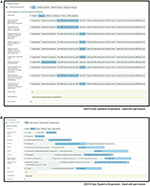
Effigy 1. Screenshots of the Memory Disorders SDCS toolkit inside the EMR. (A) Functional activities questionnaire, (B) Barthel Index.
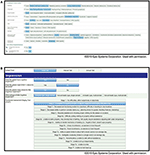
Figure 2. Screenshots of the Retention Disorders SDCS toolkit within the EMR. (A) Current symptoms, (B) initial visit impression.
Similarly, if nosotros find ii measures are highly correlated, nosotros can consider whether both need to be included. Additionally, these reports allow us to examine the data for expected relationships and to sympathise our patient population. For instance, we tin stratify these reports co-ordinate to degree of harm, producing one for patients with MCI and 1 for patients with dementia, for comparison.
We are likewise using the toolkit to identify quality improvement opportunities at the indicate-of-care, allowing the physician to take firsthand action. As a department based initiative, we have adult Best Exercise Advisories (BPAs) that alert the neurologist when a patient screens positive for depression and feet. When alerted, the neurologist must provide information on whether action was taken (referral, medication prescribed, etc.) or not. If non, a reason must be provided from a driblet-down menu. We programme to evaluate the impact of our depression BPA by assessing clinical measures of depression and quality of life, earlier and after the implementation of this BPA. We are also planning like BPAs specific to patients in our memory clinic. For case, when a patient'due south FAQ suggests difficulty with financial direction tasks, we plan to appraise the frequency that a social worker referral is ordered. Besides, we plan to assess how frequently a driving evaluation is ordered if a patient has a positive driving safety screen.
Similarly we could consider whether patients with evidence of cognitive disorder as evidenced by the MoCA or STMS, take neuropsychiatric testing or advanced care planning documented. Lastly, in patients reporting falls within the by year, we plan to assess the frequency with which a physical therapy referral is ordered. In one case these are implemented, nosotros can assess the effectiveness past determining whether in that location is a change in doctor behavior and how these changes relate to patient outcomes.
To complement the clinical data, nosotros are too using the toolkit to enroll patients in our IRB canonical Dna biobanking study. We developed a BPA that is triggered if patients meet the eligibility criteria for our Dna biobanking study. The BPA prompts the consenting of the patient and subsequent enrollment at the bespeak of care (NorthShore IRB approved study EH10-139). These patients consent to a ane-time blood depict, but otherwise, no study specific visits are required. Data is completely captured within the context of the role visit through use of the toolkit. Genome-wide SNP genotyping was recently completed on these patients and volition be used to complement the clinical data and comport novel studies of biomarkers and risk assessment. Lastly, we are actively sharing this toolkit through the Neurology Do Based Research Network (NPBRN), which we created through a grant from AHRQ. The NPBRN partner sites prefer relevant toolkits at their site for the purposes of data sharing, to benchmark performance and to conduct quality improvement initiatives and practice-based research. For information regarding joining the NPBRN, please contact the corresponding writer (DMM). Lastly, we are also enrolling patients in a point-of-intendance clinical trial for patients with MCI using a sub-group based adaptive design (SUBA) (NorthShore IRB approved report EH14-355) (34). We are comparing the effectiveness of three nootropic drugs. Although it is a randomized trial, it is conducted in a real clinical setting, with no study specific office visits. This trial is currently in progress.
Advantages and Limitations
Nosotros draw here our experience with creating and implementing a customized toolkit to treat patients presenting with cerebral complaints. The advantage of our approach is that it is a doctor-driven process. The foundation of the toolkit is supporting Best Practices for clinical intendance. From this, we can conduct clinical inquiry at the point-of-care, as described. Data extraction from clinical data is challenging considering of heterogeneity in data entry. Our toolkit has the advantage of being highly discretized, collecting hundreds of fields of data at each encounter. This makes extraction, reporting and information analysis much more accessible. We too generate frequent descriptive and analytic reports providing feedback to clinicians on their patients and the utility of toolkit usage. The toolkit also streamlines the office visit by assigning tasks to different members of the care team. Standardization of care likewise makes longitudinal comparison easier. In the toolkit, repeated measures tin be hands visualized, allowing the medico to encounter changes over fourth dimension quickly. This also presents the opportunity for longitudinal research. We currently accept nearly 3 years of longitudinal data on these patients that can be examined for quality improvement and practice based-research studies. Lastly, the standardization of data allows for collaborative research initiatives through data sharing. Multi-site research is often challenging because of differences in data drove. Standardized data collection allows the opportunity to assess quality and research questions in various patient populations beyond geographic sites, all with comparable data.
Conclusion
The EMR presents a novel opportunity to improve patient care through quality cess and inquiry initiatives. We demonstrate here the cosmos of a standardized EMR that we are currently using in clinical practice to conduct quality initiatives and do-based research. Through these projects, we strive to identify opportunities to ameliorate intendance and outcomes for patients living with cognitive disorders.
Ideals Statement
Written informed consent was not obtained for assessment using the EMR toolkits, equally this was done in the grade of routine clinical practice. Written informed consent was obtained for the extraction and storage of Deoxyribonucleic acid, equally function of a separate study. The Dna drove protocol was approved by the NorthShore University HealthSystem Institutional Review Board.
Author Contributions
SM, RF, and DM adult the toolkit and contributed conception and design of the study. CY contributed information and report conception and design. Other data contributors are JC and LG. RC, RL, and LH too developed the toolkit. ST contributed statistical support. KS wrote the start draft of the manuscript. All authors contributed to manuscript revision, read, and approved the submitted version.
Funding
This piece of work was supported by the Agency for Healthcare Research and Quality (R01HS024057) awarded to DM.
Conflict of Involvement Statement
The authors declare that the research was conducted in the absence of whatsoever commercial or financial relationships that could be construed as a potential conflict of interest.
Acknowledgments
The authors acknowledge the generous funding support of the Auxiliary of NorthShore University HealthSystem with respect to the initial edifice of electronic medical record (EMR) toolkits, and thank the medical assistants, nurses, neurologists, EMR Optimization, and Enterprise Data Warehouse programmers, administrators, and research personnel at NorthShore University HealthSystem who contributed to the quality improvement and practice-based inquiry initiative using the EMR.
The authors thank Vimal Patel, Ph.D. and Hannah Moulthrop, Thousand.S., for their assistance with editing, copy-editing, preparation of figures, formatting, and submitting the manuscript for publication.
Supplementary Material
The Supplementary Material for this article tin can be constitute online at: https://world wide web.frontiersin.org/manufactures/x.3389/fneur.2019.00161/full#supplementary-material
References
ii. Alzheimer'southward Association. 2016 Alzheimer's illness facts and figures. Alzheimers Bewilder. (2016) 12:459–509. doi: ten.1016/j.jalz.2016.03.001
CrossRef Full Text
5. Petersen RC, Roberts RO, Knopman DS, Geda YE, Cha RH, Pankratz VS, et al. Prevalence of mild cognitive impairment is higher in men. the mayo clinic written report of aging. Neurology. (2010) 75:889–97. doi: 10.1212/WNL.0b013e3181f11d85
PubMed Abstract | CrossRef Full Text | Google Scholar
six. Geda YE, Roberts RO, Mielke MM, Knopman DS, Christianson TJ, Pankratz VS, et al. Baseline neuropsychiatric symptoms and the risk of incident mild cognitive damage: a population-based study. Am J Psychiatry. (2014) 171:572–81. doi: ten.1176/appi.ajp.2014.13060821
PubMed Abstruse | CrossRef Full Text | Google Scholar
vii. Ismail Z, Elbayoumi H, Fischer CE, Hogan DB, Millikin CP, Schweizer T, et al. Prevalence of low in patients with mild cognitive damage: a systematic review and meta-analysis. JAMA Psychiatry. (2017) 74:58–67. doi: 10.1001/jamapsychiatry.2016.3162
PubMed Abstruse | CrossRef Full Text | Google Scholar
8. Boccardi V, Conestabile Della Staffa M, Baroni M, Ercolani S, Croce MF, Ruggiero C, et al. ReGAL report grouping. prevalence and correlates of behavioral disorders in old age subjects with cerebral impairment: results from the Regal projection. J Alzheimers Dis. (2017) threescore:1275–83. doi: x.3233/JAD-170494
CrossRef Total Text | Google Scholar
ix. Van der Mussele S, Mariën P, Saerens J, Somers Northward, Goeman J, De Deyn PP, et al. Behavioral syndromes in mild cognitive impairment and Alzheimer'due south disease. J Alzheimers Dis. (2014) 38:319–29. doi: 10.3233/JAD-130596
PubMed Abstract | CrossRef Full Text | Google Scholar
13. Allegri RF, Sarasola D, Serrano CM, Taragano FE, Arizaga RL, Butman J, et al. Neuropsychiatric symptoms as a predictor of caregiver burden in Alzheimer's disease. Neuropsychiatr Dis Care for. (2006) 2:105–10.
PubMed Abstract | Google Scholar
15. Sheikh F, Ismail Z, Mortby ME, Barber P, Cieslak A, Fischer Chiliad, et al. PROMPT registry investigators. prevalence of mild behavioral damage in mild cerebral impairment and subjective cerebral refuse, and its clan with caregiver burden. Int Psychogeriatr. (2018) xxx:233–44. doi: 10.1017/S104161021700151X
CrossRef Total Text | Google Scholar
sixteen. Okura T, Plassman BL, Steffens DC, Llewellyn DJ, Potter GG, Langa KM. Prevalence of neuropsychiatric symptoms and their association with functional limitations in older adults in the United states: the crumbling, demographics, and retentivity study. J Am Geriatr Soc. (2010) 58:330–7. doi: 10.1111/j.1532-5415.2009.02680.x
PubMed Abstruse | CrossRef Full Text | Google Scholar
17. Okura T, Plassman BL, Steffens DC, Llewellyn DJ, Potter GG, Langa KM. Neuropsychiatric symptoms and the risk of institutionalization and expiry: the crumbling, demographics, and memory study. J Am Geriatr Soc. (2011) 59:473–81. doi: 10.1111/j.1532-5415.2011.03314.x
PubMed Abstruse | CrossRef Full Text | Google Scholar
18. Elliott RA, Goeman D, Beanland C, Koch S. Ability of older people with dementia or cerebral impairment to manage medicine regimens: a narrative review. Curr Clin Pharmacol. (2015) 10:213–21. doi: 10.2174/1574884710666150812141525
PubMed Abstruse | CrossRef Total Text | Google Scholar
19. Jennings LA, Palimaru A, Corona MG, Cagigas XE, Ramirez KD, Zhao T, et al. Patient and caregiver goals for dementia care. Qual Life Res. (2017) 26:685–93. doi: x.1007/s11136-016-1471-vii
PubMed Abstract | CrossRef Full Text | Google Scholar
xx. Doody RS, Stevens JC, Brook C, Dubinsky RM, Kaye JA, Gwyther 50, et al. Do parameter: direction of dementia (an evidence-based review). Report of the quality standards subcommittee of the American Academy of Neurology. Neurology. (2001) 56:1154–66. doi: 10.1212/WNL.56.9.1154
PubMed Abstract | CrossRef Full Text | Google Scholar
21. Dubinsky RM, Stein Ac, Lyons K. Practice parameter: risk of driving and Alzheimer'due south disease (an evidence-based review): study of the quality standards subcommittee of the American University of Neurology. Neurology. (2000) 54:2205–11. doi: 10.1212/WNL.54.12.2205
PubMed Abstract | CrossRef Total Text | Google Scholar
22. Iverson DJ, Gronseth GS, Reger MA, Classen S, Dubinsky RM, Rizzo M. Quality standards subcomittee of the American University of Neurology. Do parameter update: evaluation and management of driving risk in dementia: report of the quality standards subcommittee of the American Academy of Neurology. Neurology. (2010) 74:1316–24. doi: 10.1212/WNL.0b013e3181da3b0f
PubMed Abstract | CrossRef Total Text | Google Scholar
23. Odenheimer 1000, Borson S, Sanders AE, Beau-Eng RJ, Kyomen HH, Tierney S, et al. Quality comeback in neurology: dementia management quality measures. Neurology. (2013) 81:1545–ix. doi: 10.1212/WNL.0b013e3182a956bf
PubMed Abstruse | CrossRef Full Text | Google Scholar
24. Thurman DJ, Stevens JA, Rao JK. Quality standards subcommittee of the American Academy of Neurology. Practice parameter: assessing patients in a neurology practice for risk of falls (an evidence-based review): written report of the quality standards subcommittee of the American Academy of Neurology. Neurology. (2008) lxx:473–9. doi: 10.1212/01.wnl.0000299085.18976.20
PubMed Abstract | CrossRef Full Text | Google Scholar
25. Petersen RC, Lopez O, Armstrong MJ, Getchius TSD, Ganguli G, Gloss D, et al. Practice guideline update summary: mild cerebral harm: study of the guideline evolution, dissemination, and implementation subcommittee of the American Academy of Neurology. Neurology. (2018) 90:126–35. doi: 10.1212/WNL.0000000000004826
PubMed Abstract | CrossRef Total Text | Google Scholar
26. Maraganore DM, Frigerio R, Kazmi N, Meyers SL, Sefa Yard, Walters SA, et al. Quality improvement and practice-based research in neurology using the electronic medical record. Neurol Clin Pract. (2015) five:419–29. doi: x.1212/CPJ.0000000000000176
PubMed Abstract | CrossRef Total Text
29. Yesavage JA, Brink TL, Rose TL, Lum O, Huang V, Adey Grand, et al. Development and validation of a geriatric depression screening calibration: a preliminary study. J Psychiatr Res. (1982–1983) 17:37–49. doi: ten.1016/0022-3956(82)90033-iv
PubMed Abstract | CrossRef Full Text
30. Pfeffer RI, Kurosaki TT, Harrah CH Jr, Chance JM, Filos S. Measurement of functional activities in older adults in the community. J Gerontol. (1982) 37:323–9. doi: ten.1093/geronj/37.3.323
PubMed Abstract | CrossRef Full Text | Google Scholar
31. Nasreddine ZS, Phillips NA, Bédirian V, Charbonneau S, Whitehead V, Collin I, et al. The Montreal cognitive assessment, MoCA: a cursory screening tool for mild cerebral impairment. J Am Geriatr Soc. (2005) 53:695–9. doi: ten.1111/j.1532-5415.2005.53221.x
PubMed Abstruse | CrossRef Full Text | Google Scholar
33. Folstein MF, Folstein SE, McHugh PR. "Mini-mental state." A applied method for grading the cognitive land of patients for the clinician. J Psychiatr Res. (1975) 12:189–98. doi: 10.1016/0022-3956(75)90026-6
PubMed Abstract | CrossRef Full Text | Google Scholar
Source: https://www.frontiersin.org/articles/10.3389/fneur.2019.00161/full
0 Response to "Practice Parameter Management of Dementia (an Evidence-based Review)"
Postar um comentário