How to Get Past the 1meg Upload Limit With Isp

What is bandwidth for streaming? What's the departure between bandwidth and speed? How much bandwidth do you need for 1080p streaming? We've got answers.
Jump to
What is bandwidth?
Bandwidth is the capacity of a network to upload and download data. Internet bandwidth is the maximum volume of data you can send and receive in a measured corporeality of fourth dimension. It's generally calculated in megabits per second (Mbps).
When streaming video to the Cyberspace, yous are consuming upload bandwidth. It's essential to know your network's available upload bandwidth because it enables (and also limits) the quality of your outgoing streams.
Available bandwidth depends on the network router, surroundings, and most importantly, the connexion type. For example, dial-up Internet had a maximum bandwidth of just 56 kilobits per second (Kbps). In contrast, more modernistic connection types like fiber-optic landline (622 Mbps), Gigabit Ethernet (1,000 Mbps), and 4G LTE (100 Mbps) take much higher bandwidths.
Bandwidth vs. speed
Diverse online speed tests offer to test how fast your network is. But is that the same as bandwidth? Not quite. "Bandwidth" and "speed" are often used interchangeably, all the same at that place is a difference betwixt these two terms.
If bandwidth is the maximum rate for information transfer, speed is how fast data is factually downloaded or uploaded. Like bandwidth, the connexion speed is also measured in Mbps.
Since live streaming involves uploading data to the Internet, having ample upload speed is important. In fact, for successful alive streaming, you'll need both sufficient upload bandwidth and upload speed.
Solutions you can stake your reputation on
Built for pro AV, Epiphan's rugged and reliable hardware encoders permit you capture, stream, and record with conviction. Wherever your product teams take them, Epiphan Cloud's configuration and monitoring streamline management.
As with download speed, upload speed has a set rate (due east.g., "five Mbps upload speed") equally dictated by your Internet service provider (Internet service provider). Considering bandwidth sets the upper limit for the data transfer rate, in that location'southward no sense in purchasing Internet speeds from your Internet service provider that exceed your maximum bandwidth.
Bandwidth vs. bitrate
Because raw video and sound are too hefty to upload, streamed content needs to be encoded. Encoding compresses video and sound content into a size and format that'due south easy to ship to the Cyberspace.
Bitrate is the amount of information encoded per unit of measurement of time. When it comes to streaming, information technology's usually measured in Kbps, and less frequently in Mbps. By and large speaking, the college the bitrate, the college the video quality, and the college the upload bandwidth required.
To encode your content, you'll use either a software encoder or a hardware encoder (like Pearl Nano, Pearl Mini, or Pearl-2). You will ready the bitrate in your encoder settings.
The total bitrate consists of the video and audio bitrates. The bitrate setting will depend on the video resolution and frame rate. For higher resolutions and frame rates, you'll need higher bitrate settings. For example, the recommended encoding settings for 4K streaming at 60 frames per second (fps) will exist higher than that for 1080p streaming at xxx fps. Insufficient bitrate will cause your stream to appear choppy.
How much bandwidth do I need for live streaming?
The amount of bandwidth you'll demand depends on your encoding bitrate. For example, if you are encoding at 3,000 Kbps, you will need at least 3 Mbps of upload bandwidth. If your stream'due south bitrate is too high relative to your upload bandwidth, your live stream volition exist unreliable for viewers. For instance, a stream with a 6,000 Kbps bitrate doesn't piece of work on a network with a 5 Mbps upload bandwidth limit.

To a higher place are the general required bandwidth for streaming guidelines. For example, the minimum bandwidth required for 1080p (HD) streaming is 5 Mbps, while the minimum 4K (UHD) streaming bandwidth is around 25 Mbps.
Different platforms (eastward.g., YouTube, Twitch, Facebook) have different speed requirements and recommended encoding settings. So be sure to double-check earlier streaming.
How to ensure you have enough bandwidth for streaming
It's unproblematic math to realize that if yous accept v Mbps of upload bandwidth, your stream bitrate should exist less than 5 Mbps. But just how much less? Bandwidth limitations are simply office of the story! You lot'll need to consider some additional factors to ensure the success of your live stream.
Ever have some extra bandwidth (and upload speed) available
Ensure y'all always accept enough bandwidth for streaming your circulate – plus more. This additional headroom acts as a buffer to business relationship for any changes to your network. Whatsoever user activeness on your network (eastward.one thousand., Cyberspace uploads, VoIP communication, gaming) tin impact both bandwidth and upload speed.
Utilize the simple formula below to estimate the required bandwidth for streaming:
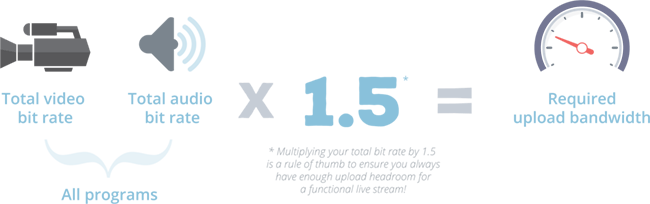
We recommend always having near 1.5x your stream'due south bitrate available to account for these possible network fluctuations. For example, if your live stream has a bitrate of 5,000 Kbps (5 Mbps), ensure you take at to the lowest degree vii.v Mbps total upload bandwidth available to provide a reliable live stream. You may not demand all of the calculated overhead bandwidth on a stable network, but information technology's always best to be on the safe side.
Consider your network and connexion type
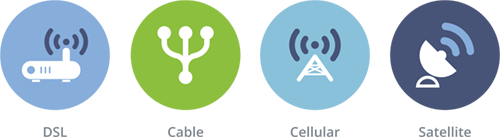
Equally nosotros mentioned, there are many different types of Internet connectivity, including fiber-optic, cablevision, satellite, and cellular data. Before live streaming, consider the varying levels of available bandwidth and network reliability each option offers.
For example, wireless cellular Internet tends to accept lower maximum upload bandwidth and reliability, resulting in a lower-quality stream. Or peradventure y'all live in a rural area and have a satellite connection. In that instance, you might want to take weather into business relationship before publishing your stream.
Cobweb and cablevision connections generally offering college speeds, which are all-time suited for alive streaming. For improved reliability, it'south always best to employ a hardwired Internet connection over Wi-Fi or cellular.
Consider Internet service provider upload speeds and information caps
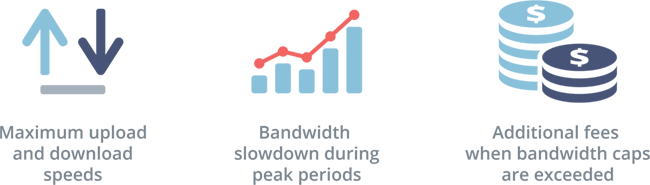
Many ISPs annunciate upload and download bandwidth in terms of maximum and minimum speed.
For instance, an Cyberspace package might be advertised as "Up to 10 Mbps up and thirty Mbps down". This detail "upward to" phrasing is used because Net speeds can vary. If using a cable network, for example, you lot're sharing the Internet with other cable users within a geographical expanse, so your bandwidth may slow during "superlative" periods of Internet activity during the solar day.
Some ISPs too accept bandwidth usage maximums – so exist enlightened your live stream doesn't become beyond your monthly upload cap, or y'all may exist charged additional fees.
 Running an Internet speed test is also important. Y'all may accept plenty available bandwidth on your network but non enough upload speed, depending on how many devices are sharing the network and the types of activities on those devices.
Ensure you accept additional bandwidth if streaming multiple programs
Multi-streaming is an increasingly popular alive streaming strategy that involves publishing your circulate to more than than ane content distribution network (CDN) platform simultaneously. Multi-encoding, on the other manus, is a like technique that involves streaming the aforementioned program to the aforementioned CDN at dissimilar bitrates. Multi-streaming allows live streams to reach a greater audience, while multi-encoding helps to ensure accessibility of your live stream to viewers of all levels of download bandwidth.
Go on in mind that each additional plan you publish adds to your total outgoing bitrate and requires additional upload bandwidth availability.

The final discussion
As you can see, the required bandwidth for streaming for a reliable live circulate depends on a diversity of factors. While there is no "one size fits all" configuration, balance assured that with the right tweaking yous can publish a successful and reliable live stream regardless of your network.
And remember—as a general rule of thumb, we recommend your streaming upload bandwidth exist at least one.5x the combined bit rate of all your streamed programs (when streaming in SD or above). Happy streaming!
What are some of the most common issues y'all've experienced with bandwidth for streaming? Let us know in the comments!
Originally published on July 31, 2019 this post was updated on October 14, 2021.
Source: https://www.epiphan.com/blog/bandwidth-for-streaming/
0 Response to "How to Get Past the 1meg Upload Limit With Isp"
Postar um comentário